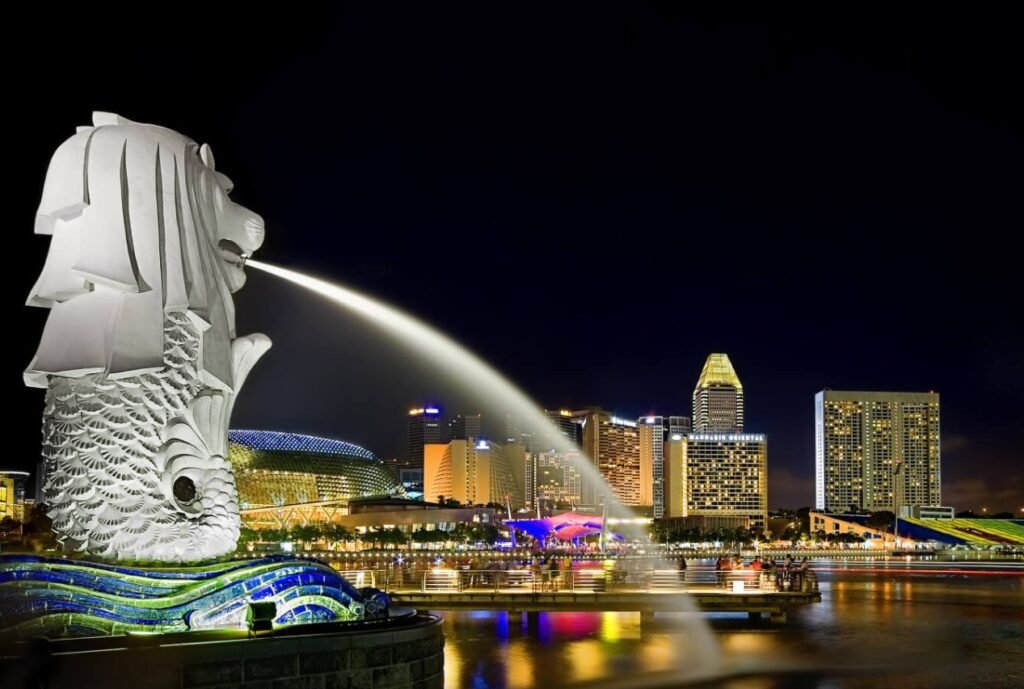
The original Merlion Park was first designed by the Singapore Tourism Board (STB) near the mouth of the Singapore River in 1964 as an emblem of Singapore. On 15 September 1972, the park was officially opened at an installation ceremony for the statue, officiated at by then Prime Minister of Singapore, Mr Lee Kuan Yew.[1] The original statue of the Merlion used to stand at the mouth of the Singapore River. The building of the Merlion was started in November 1971 and was completed in August 1972. It was crafted by the late Singaporean sculptor, Mr Lim Nang Seng[2] and his 8 children. The sculpture measures 8.6 meters high and weighs 70 tons.[3][4] This massive statue with the spouting stream was constructed by Stanley Mok [5]

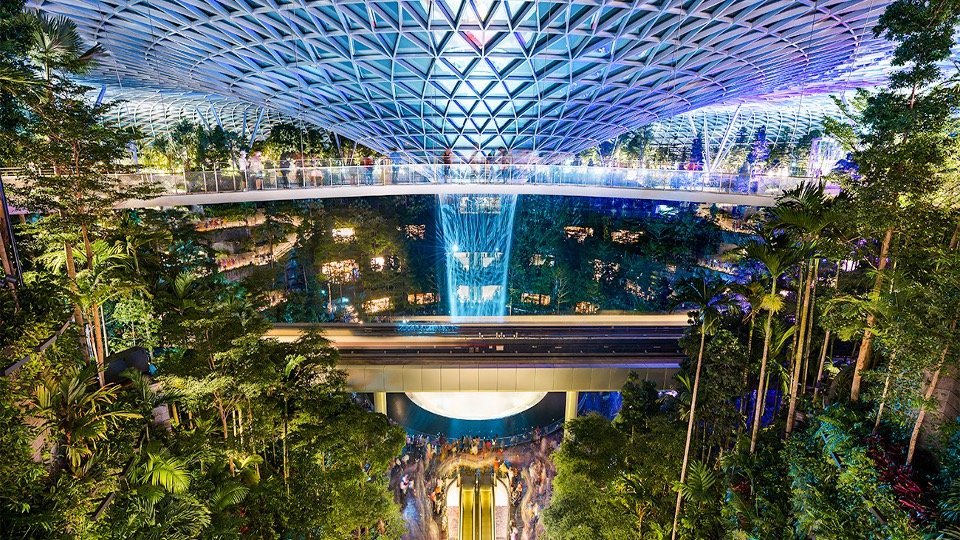
ewel Changi Airport (also known as Jewel) is a nature-themed entertainment and retail complex surrounded by and linked to Terminals 1, 2, and 3 of Changi Airport in Singapore. Its centrepiece is the world’s tallest indoor waterfall, the Rain Vortex, which is surrounded by a terraced forest setting.[5] Jewel includes gardens, attractions, a hotel, about 300 retail and dining outlets, as well as early baggage check-in facilities. It covers a total floor area of 135,700 m2 (1,461,000 sq ft), spanning ten storeys—five above-ground and five basement levels.[6]
Attractions include the Forest Valley, an indoor garden spanning five storeys; and the Canopy Park at the topmost level, featuring gardens and leisure facilities.[7] Jewel receives about 300,000 visitors per day. In October 2019, six months after its soft opening, it welcomed 50 million visitors, exceeding its initial target for the whole year.[2] In 2024, it achieved a record footfall of more than 80 million, the highest since its opening.[8] The complex and airport are located in Changi, at the eastern end of Singapore, approximately 20 km (12 mi) northeast from Singapore’s Downtown Core.[9]

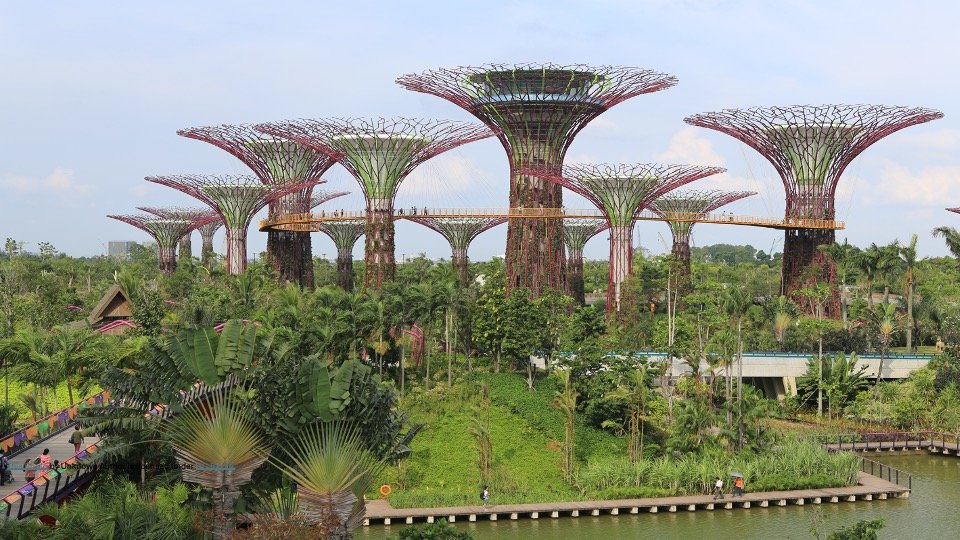
These structures tower over the three distinctive gardens that make up Gardens by the Bay – Gardens at Marina South, Gardens at Marina East and Gardens at Marina Central – and they serve as conservatories to a diverse range of plants from different climatic zones. Collectively, Gardens by the Bay provides the experience that Singapore is more than a place to work – it is also a compelling destination to live and play. It demonstrates that the boundary of garden design can be pushed beyond landscaping and horticulture to include a multitude of disciplines ranging from architecture to structural and environmental engineering. More importantly, Gardens by the Bay is testament to Singapore’s development experience as it signifies the maturity of Singapore’s Garden City concept.
Put in place by former Prime Minister Lee Kuan Yew in 1967, the Garden City concept integrates the natural environment into Singapore’s development and has been instrumental in creating a manicured environment of trees, flowers, parks and rich biodiversity. The opening of Gardens by the Bay, however, signifies the beginning of the next phrase of garden development in Singapore. Instead of creating parks and gardens, Gardens by the Bay launches the City in a Garden vision that aims to bring parks and green spaces into people’s homes and workplaces. By journeying through the development of the various parks, gardens and green spaces in Singapore over the years, this article not only examines the dynamics behind Singapore’s Garden City development strategy, but also shows how the Garden City concept has evolved into the City in a Garden vision.

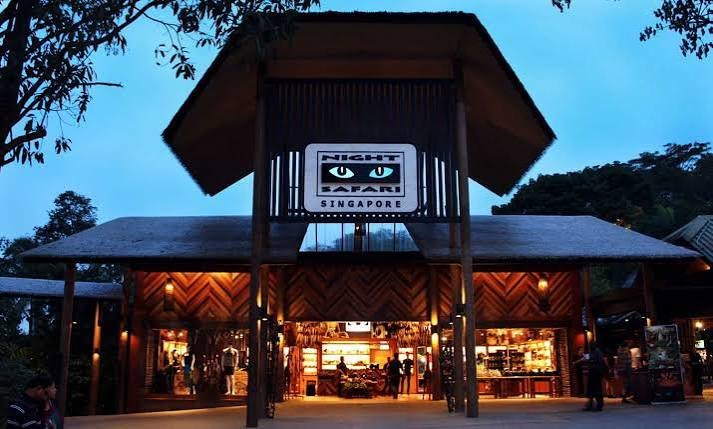
Night Safari is the world’s first nocturnal zoo,[3] located in Mandai, Singapore. One of the country’s most popular tourist attractions, it is one of five Mandai Wildlife Reserve parks, including Singapore Zoo, Bird Paradise, River Wonders, and Rainforest Wild ASIA.
The concept of a nocturnal park in Singapore was suggested in the 1980s by the former executive chairman of the Singapore Zoo, Ong Swee Law. Constructed at a cost of S$63 million, the Night Safari was officially opened on 26 May 1994 and occupies 35 hectares (86 acres) of secondary rainforest adjacent to the Singapore Zoo and Upper Seletar Reservoir.
The Night Safari currently houses over 900 animals representing over 100 species, of which 41% are threatened species.[1] The Night Safari is managed by Mandai Wildlife Group, and about 1.3 million visitors visit the safari per year.[4][2] The Night Safari received its 11 millionth visitor on 29 May 2007.

Originally built in 1894, what was unqiue about this Lau Pa Sat (literal translation is the old market) was that “it is the largest remaining Victorian filigree cast-iron structure in Southeast Asia”. I got the quote from a official website promoting Singapore attractions. I don’t know much about Victorian architecture or filigree structures (means delicate ornamental designs made with wire…I checked the dictionary) but the place does indeed have a grandeur and elegance about it.
My dad often brought me to Lau Pa Sat when I was young, after he had finished doing his errands in the city area. This was before the place had been “restored” by the government. I remember distinctly the bewilderment I felt at being swamped by the thongs of people having their lunch there. It was noisy, hot, crowded and dirty. On many occasions you had to share tables with total strangers. Eating habits of Singaporeans then were less refined – bones and food remnants were ejected with wild abandon onto the tables. Taking into account that I was quite a spoilt brat then, I absolutely hated the place. Conversly, my dad loved the place as there were many food stalls there that were legendary in local lore.

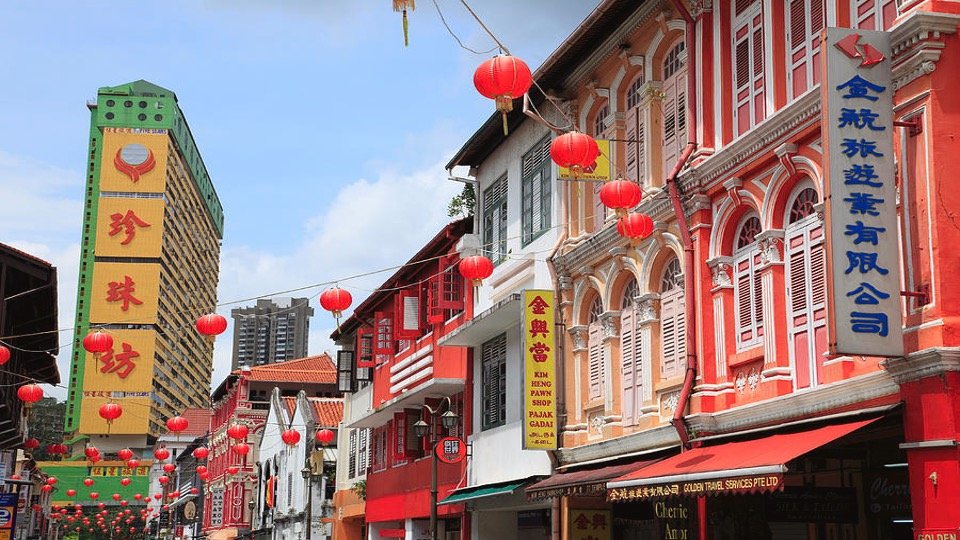
Chinatown’s physical development began from 1843, when more land leases and grants for homes and trade were awarded – particularly around Pagoda Street, Almeida Street (today’s Temple Street), Smith Street, Trengganu Street, Sago Street and Sago Lane. In John Turnbull Thomson’s 1846 map, this ethnic quarter expanded to the area demarcated by Telok Ayer Street, Singapore River, New Bridge Road and Pagoda Street. Developed areas by this time included Upper Macao Street (today’s Upper Pickering Street), Upper Hokkien Street, Upper Chin Chew Street, Upper Cross Street and Mosque Street.
Due to the overcrowding and congestion, major upgrading of shophouses and new developments took place at the end of 1983, and the street hawkers were housed in Kreta Ayer Complex. Contrary to its name, Chinatown is not exclusively Chinese. It also had small communities of Indian traders around the junction of South Bridge Road and Upper Cross Street; Indian temples and Muslim mosques can be found in the area too.

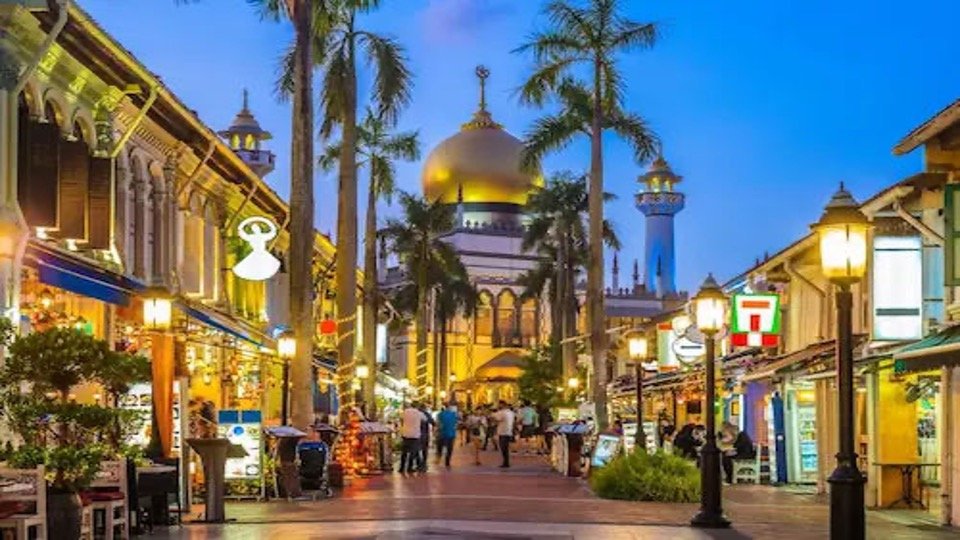
In 1824, British colonial officer Sir Stamford Raffles gave Sultan Hussein Shah of Johor a vast 56 acres (23 ha) expanse in Kampong Glam, which became the land that the Istana Kampong Glam would occupy. In the 1840s, Sultan Ali Iskandar Shah, son of Sultan Hussein Shah, hired George Drumgoole Coleman to build the Istana there. Coleman reflected a blend of Palladian architectural elements with indigenous Malay motifs.[1][2] The 2026 discovery of a stencilled sign and an 1891 newspaper article hints that the building might only have been completed in 1890. Further testing of the building’s age is pending.[3]
Following a succession dispute in 1896, the estate transitioned to state ownership. In 2004, as an integral facet of the Malay Heritage Centre initiative, restoration efforts were undertaken.
Malay Heritage Centre
After extensive restoration efforts, the palace grounds were refurbished into the Malay Heritage Centre, officially inaugurated in June 2005 with Prime Minister Lee Hsien Loong leading the ceremony. This transformation provided a platform for visitors to engage with Singapore’s diverse cultural heritage. Furthermore, during the SG50 National Day celebrations, the site received the distinction of being designated as a national monument, highlighting its importance in Singapore’s historical and cultural fabric.[4]

The Singapore Flyer[a] is an observation wheel at the Downtown Core district of Singapore. Officially opened on 15 April 2008, it has 28 air-conditioned capsules, each able to accommodate 28 passengers, and incorporates a three-story terminal building.[5][6] The flyer has made numerous appearances in media and popular culture that features Singapore.
The Flyer has an overall height of 165 metres (541 ft), making it the world’s tallest Ferris wheel upon completion. It was surpassed by the High Roller Ferris wheel which opened in 2014 in Las Vegas, Nevada, United States, with a height of 167.6 m (550 ft), making it 2.6 m (9 ft) taller than the Flyer.[7][8]
History
The Singapore Flyer was first conceived in the early 2000s by Patrick MacMahon of Melchers Project Management, a subsidiary of German company Melchers. Formal planning commenced in 2002. A new company, Singapore Flyer Pte Ltd, was formed as the developer, with Melchers Project Management holding a 75% stake, and the remainder held by Orient & Pacific Management.[1][9]
The project was formally announced and endorsed on 27 June 2003 by the Singapore Tourism Board with the signing of a memorandum of understanding, formalising the understanding between the developer and tourism board with regard to the land-acquisition process.[1][9]
Under this agreement, the tourism board was to purchase the plot of land in Marina Centre from the Singapore Land Authority, and lease it to Singapore Flyer Pte Ltd for 30 years with an option to extend the lease by another 15 years. The land was to be rent-free during the construction phase of the project. In July 2003, Jones Lang LaSalle was appointed as the real estate advisor. Takenaka and Mitsubishi were selected as the main contractors, and Arup as the structural engineer.[1][9]
In April 2005, it was announced that the completion of the Flyer was delayed to the end of 2007, instead of the end of 2005, due to financing issues by the developer.[10] In September, two German banks, Delbrueck Bethmann Maffei, the private banking arm of ABN Amro, and Bayerische Hypo- und Vereinsbank, funded $240 million resolving the financial issues faced by the developer.[11]
The groundbreaking ceremony was held on 27 September with Minister for National Development Mah Bow Tan as guest of honour. The spindle was fitted on 13 December 2006, and the outer rim was completed on 9 April 2007. Installation of the passenger capsules began on 3 August and was completed on 2 October.[12][1]
In August 2007, Florian Bollen, Singapore Flyer Pte Ltd chairman, raised his stake in the Singapore Flyer from 60% to 90% through acquisition of Melchers Project Management’s 30% stake. The deal was done via AAA Equity Holdings, a private investment vehicle headed by Bollen. Orient & Pacific Management, which spearheaded the project development management, owns the remaining 10%.[1][9]
The Flyer opened in 2008. During Chinese New Year, corporate ‘inaugural flights’ were held from 11 to 13 February, tickets for which sold out for S$8,888, an auspicious number in Eastern culture. The first public rides were on Valentine’s Day, 14 February, the soft launch on 1 March,[2] and the official opening on 15 April, at which Prime Minister Lee Hsien Loong was the guest of honour.[1][13]
In end May 2013, the Flyer was placed under receivership after failing to repay financial obligations to its financing banks.[14] In July, Merlin Entertainments, operator of the London Eye was interested to acquire the Flyer but the idea were abandoned by May 2014.[14]
On 28 August 2014, Straco Leisure Pte Ltd announced the acquisition of Singapore Flyer at S$140 million after embezzlement and financial issues with the now defunct predecessor company, Great Wheel Corporation.[14][15] Straco Leisure Pte Ltd is 90% owned by Straco Corporation Limited, a Singaporean listed company that operates tourist attractions in China such as the Shanghai Ocean Aquarium and Underwater World Xiamen. The remaining 10% is owned by WTS Leisure Pte Ltd, one of the largest private tour bus operators in Singapore.[4]